Showing posts with label OTTBS. Show all posts

Tuesday, April 02, 2013

Change it up

Most horses--like most cats, dogs and humans--can have a hard time with change. Calabar is no different and may in fact be a little bit more hard over on the "I like it this way" side of things. Nevertheless, in all things the only constant is change. And in this case, it was a matter of one horse's change leading to a big change for my own big brown horse.

Our newest rehab, Lucky Culprit, is a drop-dead gorgeous 17 hand Off-Track Thoroughbred. He is drool worthy. Seriously. But.. he was a bit nervous about switching from his tried and true routine at the track to this wide open paddock in the boonies of Sebastopol. To counteract his change of scenery and switch to this more rural lifestyle, he amused himself by chewing on the trees in his new wide open paddock. .

Lucky Culprit (Clyde) and his buddy Karen
This is not a productive use of an OTTBs time and the barn owner prefers that trees stay standing, especially since they provide shelter and shade for said paddock.

The facility is, however, full--unless we were to put Lucky (aka Clyde) in a stall which seemed like a not so good plan--so we needed another alternative. In this case, it was swapping Clyde with Calabar which seemed like a simple solution.

Simple to us, not so much to Calabar.

"Where am I?!" "Why am I HERE, wherever that is, and not where I belong?!" Zoom, zoom, spin, buck, rear, repeat.


I admit this is my fault. He has been in the same paddock for five years, followed roughly the same routine and watched the barn activity from the same vantage point the whole time. Might have been good to change things up a little but, as they say, hindsight does not need glasses.

Clyde settled in nicely between Lena and Dixie and the two mares threw Calabar over like an old pair of dancing shoes. Hopefully, Calabar won't know this since he is across the property from all the shameless flirting.

This was not the birthday present my horse envisioned. (He turned 13 yesterday--yep, April Fools day. It suits him.) Carrot cake, apples, jumping over things--all of this would have been acceptable. A whole new place in space? Not so much.

He took two days or so to settle in and is still in super watchful mode. He does appreciate being the first horse everyone greets when they pull in and the last horse they wave to on their way out. But. Forrest is not Lena. The mules next door are weird looking. He has to learn a whole new routine and it is unsettling. He is unsettled. Or he was. Today I noticed a very large, flattened place in the mud with a roughly Calabar-shaped outline indicating nappage. It coincided with the evenly-placed mud on the Thoroughbred who moseyed up to me to get his treats.

He is still concerned. I get a giraffe every now and then--head up, eyes wide--but it's a little less every day. On the plus side, he is turning to me for comfort and guidance and Clyde seems to have given up chewing in favor of flirting, so perhaps this will be a good learning tool for all of us.

In the meantime, I am reassuring Calabar with routine--still doing the same stuff, just starting from a slightly different place at the farm.

I think in the long run (or maybe even the short it will be good for him. It is in fact something we should have done with him before, if only to break up the herd-bound behavior between Lena and Calabar.

Back to hindsight and better vision.

Just when I think I've had an epiphany, something smacks me in the back of the head and reminds me how much more I have to learn. In this case, it's two big, brown Off-TrackThoroughbreds showing me this piece of the universe I've missed.

Not such bad teachers as it turns out--not so bad at all.

Thursday, March 28, 2013

Time flies when..

Well, maybe time just flies as you get older. And busier. And more interested in fuzzy noses than time in front of the computer.

Fuzzy noses are way better than most things digital, I have to say.

My favorite fuzzy nose
And there are plenty of fuzzy noses to smooch these days. Calabar (still number one, I swear), Lena, Dixie and now Lucky Pulpit, aka Clyde. Forrest gets smooches, too, but he is way more interested in food than kisses from me.

But lest you think my horses are as neglected as my blog, I will provide photographic proof that is not the case.

Calabar's weight (after a bit of a struggle this winter) is looking really good. In fact, someone called him "almost chubby" the other day. I can still feel his ribs. Mostly. Under a fine layer of, um, muscle I think.

Dirty, healthy Thoroughbred
Lena looks great, as always, and despite what she told me tonight, is getting enough attention. Maybe not as much riding as she needs or as much grazing as she wants, but there is never quite enough of either as far as she is concerned.

Obviously, a concerted rolling effort took place here.
Dixie continues to expand her horizons in the outdoor world. She watches the barn happenings, plays with her neighbors and supervises pen cleaning with a practiced eye. Now that she is out of a stall, her appetite has increased ten-fold and she is finally putting on weight. Her face and eye have softened, too, and--now that she's well-healed--we are beginning to work on the next steps towards not being a racehorse.

I'm so cute, how can you resist me?
At the risk of making it look like Dixie is my favorite, I have to include one more shot of her. Maybe two. No. I'm not keeping her.

Love the soft eye and happy ears. 
Dixie-out-of-the-stall is a completely different horse than Dixie-in-the-stall. She says she likes it this way. A lot. With mud especially.

Dixie the muddy ranch pony
Clyde is still getting used to the out-of-the-stall thing, but he is adapting nicely and, as my friend Karen says: "Hubba, hubba." He is the very definition of tall, dark and handsome PLUS he moves beautifully. He's not altogether sure about what his new job is, yet, but he wants one.

Can you say Dressage horse in the making? I can.
So, as you can see I have plenty keeping me away from the computer screen even above and beyond my day job (which I also love.)

Bar and Lena are definitely not up for adoption, but both Dixie and Clyde are and I am happy to share my addiction (and nose smooches) with anyone who is interested. I'm just glad to have these horses wander through my life on their way to new homes and careers. 

Feeling busy but lucky--which is not too bad as life goes. 

Sunday, March 10, 2013

The true power of a horse

Horses are great gifts in a life often too full of distractions and disruptions, things that throw up roadblocks to being able to find peace and quiet in my own soul. Besides the instant relaxation that hits me with the first whiff of warm horse, there is what comes next: the teaching, the learning, the quiet realization that you are accepted for who you are and how you treat them, that they will give you back what you give to them without strings, that you will always know where you stand with them because they are incapable of dishonesty.

What are you doing back there? My itch is up here.
It is all of that and more that keeps me coming back to them day after day, what continues to reward me in sometimes small and sometimes huge ways. They remind me of who I really want to be every time I look into a big, brown eye and decide what to do next because if I am in doubt or unsure, they know it. If I am doing something that feels wrong to me, they know it. If I have not gained the trust required to ask them to do the next thing, we cannot move forward together--and together is the only thing that works with a horse.

And being that they are giant fuzzy bio-feedback devices, it is hard to mistake when things go astray.

A horse is a powerful being in and of itself--designed in every fiber of its being to move with grace guiding coiled strength. To ride a horse is to connect with that energy, feel it flow beneath you and--if you are a more gifted rider than I usually am--flow with it. I do not disparage myself out of modesty or because I'm fishing for compliments--it is merely because my goal is to have that feeling on a more regular basis. This may require an amount of letting go I've not yet achieved but would like to. Some days are better than others and some days I manage to surprise myself.

Hello, I love you won't you give me a carrot?
There is the obvious stuff, like body position and balance--those things confuse the horse trying to do what they think you want and offer the opportunity to lazy their way out of something for the horse that does not want to do what they think you want.

This is now a vintage shot -- 2007 -- of Lena and me.
I have a pelvic twist--up and to the right--that means my left seat bone is sometimes not in the saddle when I think it is. Or rather it's not there when I'm not thinking about pushing down into my seat bones evenly. This happens a lot. Some days, Calabar and Lena ignore this. Some days, we are suddenly moving in circles when I'm pretty sure I haven't asked for it. Except my butt has asked for it and they now decide that's what I want. Apparently, my horses want to be chiropractors.

Not sure this is a circle yet, but we are getting there  now
They are also amazingly good at reminding you what is real and important. Just a hint--it is not necessarily returning a text message the second you receive it. Unless you really want to try texting while flying through the air. I'm sure some people can text and ride at the same time, but Calabar has every right to expect my full attention if I'm going to ask him to do trot circles instead of enjoy his pile of hay at dinner time.

But beyond the healthy (in my opinion) side-effect of taking a break from modern technology for an hour or so, there is the grounding that comes from breathing in the smells and basking in the aura of a being who does not care that you were a nerd in high school or that you still bite your fingernails and beat yourself up for this bad habit. Do you treat them with consistency and kindness? Do you represent something positive in their life? They are quick to answer that question--especially when you don't have food in your hand--by coming up to the gate to greet you and pointing happy ears in your direction, by poking their nose into the halter before you even get it unraveled, by not bucking you off when you ask something that doesn't make sense or that does not take them closer to the gate and the aforementioned dinner.

Dixie is the definition of power and grace--and she will indeed demand all your attention. NO. I am not keeping her. I swear. I think.
One of my volunteers said to me today that being around the horses has been so good for her. The simple act of picking up poop is not just good, basic physical exercise, it is an act that has clear and definite objectives that are easily completed. The poop is here, now it is in the cart, now it is in the poop pile and no longer in the stall. There are no office politics involved (or if there are, you are at the wrong barn), there are no delicate dances around sensitive topics. There is poop or there is no poop. (Though in Dixie's case, getting to the no poop side is a challenge worthy of the most meticulous stall cleaner and I'm not that person.)

"Are you sure you got all the poop?"
Really horses are a lot like that in most things. Each horse is different and each horse requires a slightly different approach, but in their world it is fairly black and white. The puzzle comes in figuring out where that line lies with each horse, then knowing how to balance on it and get the results you want while not killing the joy for either of you.

That's right--either of you.

We saw--only once, thankfully--the joy killed in one of our own horses. We allowed someone we thought had experience to ride Lena and assumed she would toss anyone who was too rough with her. We were wrong, dreadfully wrong, and our beautiful, gregarious mare who walks up and sticks her nose in the halter stopped doing that very thing. She walked away from you, into the back corner of her paddock, and shied away from the gate. That led very quickly to that person not riding her again, though not as quickly as we still wish it had been. That person tried to to control Lena without getting her cooperation, without giving her the opportunity to try and learn--even if she got it wrong sometimes--and he shut her down, turned her joy inside out into fear. Thankfully, she has recovered and is now quite happy to come out and play. The damage was not permanent though the lesson (for us, at least) definitely was.

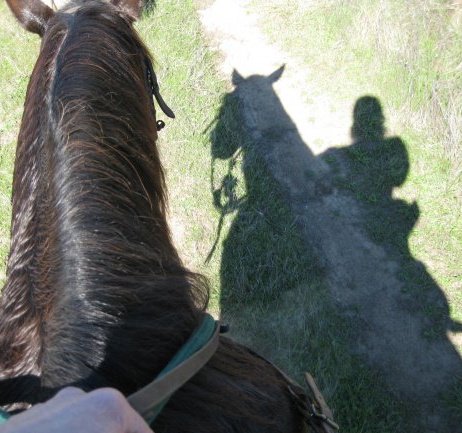
Trail shadows are good shadows
Giving up the illusion of control for the greater joy of harmony and balance is another good trick horses can teach us. I know that my control over Calabar is only as good as the deal we make minute to minute and that is based on what we've built along the way and sometimes a quick refresher course. He does not have time for my ego, nor does he care if he hurts my feelings. This is something we sometimes forget with horses, but even more often with other humans. Our goals and what drives us--sometimes not such good things eating at us--become our focus, regardless of those around us. Horses have very direct ways to remind us we are not paying attention--the ground can be a very hard thing, after all--but humans wrap things up in emotions and what is pushing at them, rather than stepping back and saying, "What could I do to change this situation in a positive way? What is my responsibility?"

Calabar saying he is not comfortable with this particular situation
That is the power of my fuzzy brown mirror, anyway, all versions of it--teak brown, spotty, bay and whatever comes next. They are amazingly quick at letting me know when--though not necessarily how--I've gotten it so incredibly wrong without hitting me with their own baggage. Or maybe it's just that their baggage really doesn't matter much because right now is more important. They certainly don't care about my bad day--unless it affects what we're doing--so why don't we just move on from here? And really, there is only feel and patience and working together NOW to get to the next thing anyway.

Horses offer us the simplest path to ourselves if we are only willing to open up and follow it. They can teach you to listen, to feel, to accept, to learn and how to just be in the moment with yourself. Life is short, even if it's long, and every moment is a chance to make it better.

Dixie says outside is better than inside and thanks for the poop clean-up , too. 


Friday, December 28, 2012

All the pretty ponies

It is a good thing I do not own a big hunk of land somewhere and am not independently wealthy. Or maybe it's not a good thing because if I did, it would be filled with so many Off-Track Thoroughbreds I could barely keep them straight.

And keeping them straight, learning each different horse and each fantastic personality, makes my days happy and full.

Of course, a certain brown OTTB would like to remind me who exactly I belong to--him, the great and wondrous Calabar and only to Calabar.

But there is Dixie (Ur My Dixie Girl), a sweet and dainty mare who is a complete stall piggy and is unfortunately stuck in said stall for another two months or so while she heals up from a hairline condylar fracture. She needs attention and mini-walks and acupressure to help combat tension from the confinement. She is adorable and quite playful. She even attempted to help with the stall cleaning tonight by bouncing the shovel handle for Katie. Too dark for a video, but there were tears of laughter at her antics.

Dixie looking at the arena: "What kind of track is that?"
And there is Cash (Cottonwood Cash), quite possibly the most mellow OTTB I've ever met. He is amazing. Doesn't spook, doesn't bit or nip, NO vices. Really. He is sweet, trusting and snuggly. Just don't try to put him in a stall. He doesn't freak out, he doesn't jig. He just flat out refuses with this look in his eye that says if you force it, bad things will happen. BAD things. But he thinks I am awesome because I just happened to be there when the farrier found the abscess in his front foot and then when the vet found the next one in his back foot. "It's a coincidence," I tell him. "But it doesn't hurt any more, so yay and thank you!" says the cute baby bay horse.

Christmas Cash--yes, he wears costumes well, too.
So.. yes. My time has been taken up with these two very lovely and very different horses. Cash never raced, not once. Dixie raced several times and was fairly successful. And yet both have been handled well and are trusting of people in general.

They are teaching me things that will give me insight into my own horse, have already given me insight into my own horse. This is good. Getting back in the saddle after all the holiday nonsense will also be good. Better in fact. Right, Calabar?

"Yes, more time with me, the #1 OTTB in your life, is crucial."
I love all the things these very different horses are teaching me. Thoroughbreds, particularly Off-Track Thoroughbreds, are not easy and they are certainly not all alike. But they do share something that engages me from the very first second--a life force, an energy, a presence. " What's next? What are you doing? How does it involve me?" In all honesty, they remind me of the cow horses I have met (and the cow horse I own) in the way they draw me in with their very being, their sensitivity, interest and attention to the world around them.

And what they give back when you reach out to them is nothing less than a gift.

Thank you to all the pretty ponies in my life for the gifts you bestow. Yes, that includes the messy stalls and the duct tape boots.

Monday, August 13, 2012

Dance partners

Trying to decide who is leading the dance.
Having a 1,100 pound dance partner can sometimes be challenging--especially when there is so much for both of us to learn. Our trot is a constant work in progress and while we are making headway, some days the discombobulation that ensues (literally) bounces between frustration and hilarity. What to do, what to do? Besides, of course, keep practicing. Well, the other night, he and I had a bit of an epiphany. Actually, I had the epiphany and he said, "It's about time!" On the heels of watching all these fabulous Olympic dressage horses dancing in time to music, I remembered how well Calabar responds to tempo changes when we do ground work. What if we tried it (gasp!) in the saddle?

Many, many people suggested humming to Calabar to help me work through my post-accident anxiety but I really hadn't done much with music. I talk to him incessantly while riding, but that doesn't help with keeping our timing on track. So the other night, I started singing to him as we trotted, encouraging him to keep a steady gait and playing with tempo as a way to get him to speed up and to slow down.

I got happy ears and we managed to do a much better job of moving forward at a steady pace than we normally do. Hm.

Steve contends that it is actually me keeping my own timing better which in turn directs Calabar more clearly. I suppose that is true, but my pony deserves some credit for pretending to enjoy my singing and for letting me lead. My equine dance partner is also a good singing coach--sideways ears and funny looks immediately occur when I wander off key. The look I get when it happens reminds me of when Katie was a little girl and didn't know what off-key meant, just told me I "sounded wrong."

Calabar has always responded  to music, likely because it was a part of his life on the track. He will speed up or slow down based on the tempo of what I'm singing and always perks his ears when he hears music from anywhere. His taste is particular, though. He doesn't like minor keys or heavy metal, for example. The neighbors were playing Led Zeppelin one afternoon and Calabar's head went straight up, eyes wide, as Robert Plant blasted out, "Been a long time since I rock and rolled." Then there was some dancing sideways until we got into the indoor arena where the guitar licks were muffled a bit. My horse appears to prefer the mellower sounds of Bonnie Raitt and The Dixie Chicks, but with this new-found entertainment, it looks like we'll have to expand our repertoire.

That being the case, and knowing my brain will only hold so many song lyrics, I have dusted off my ancient (but still functioning) iPod and there is a new playlist on it called "Calabar" based on what I think will work and some friendly suggestions. Also based on what I think I can actually sing.

And the dance continues.

Wednesday, June 27, 2012

Horses and the jobs they do

Horses need jobs. There, I said it.

There are those out there who disagree, who think admiring a horse is enough and your equine friends will be happy to be free and loose in a field just being horses. "Look at wild horses," they say, "They are happy and free!" 

But wild horses do have jobs--they have to survive. They have to move constantly, find food, mate, defend territory and raise foals. It's hard work and they don't live nearly as long in the wild as our more pampered companion horses do.

OTTBs do NOT chase bags of socks. So there.
This makes a job even more important for domesticated ponies, horses who don't actually toil hard for a living running ranches or plowing fields. In my case, this is simply working and playing in the arena and on trails and teaching Calabar new things as they come up. Like how to ignore a mechanical cow, for instance. Our current challenge is breaking up the arena routine enough that--while we still get work--we don't get bored. Oh and getting me to be brave enough to step up his training some more.

Ex-racehorses are used to having a job and a routine and plenty of people around them to help them carry that out. They are used to being busy, watching the action unfold around them and figuring out how that action may or may not affect their daily business. They are very sensitive, these athletes. Horses in general have to be to be part of the herd and also to keep from being eaten. Racehorses spend so much time with people, they sometimes seem to go on overload trying to understand what we want, what we're doing. 

Forrest View showing an OTTB can slide stop, too.
So what are good jobs for ex-racehorses? Traditionally, OTTBs have gone onto careers in eventing and dressage, as well as hunter/jumper, polo and even barrel racing and other speed events. These are all events where their speed and athleticism come into play and that use the forward propulsion they already know. The rumor is that they have the hardest time with dressage simply because of the controlled nature of it, but there are plenty of examples that they can perform at high levels as well.

Silva Martin and Sea Lord - from offtrackthoroughbreds.com
Oddly enough, that hum of energy under their skin can also be turned towards calmness and teaching in the right circumstances. The Square Peg uses several horses--including some ex-racehorses--to work with children and families dealing with autism. Yes, entire families because that's what it takes to make it all work out. In fact, they are doing a clinic on the HorseBoy Method (yes, that HorseBoy) this month and if I weren't already booked to go to Hawaii, I would be there.

Joell with Square Pegs lights up when she talks about the effectiveness of the method as a way to foster healing and communication. The workshops themselves are not designed for the kids, they are designed to give caretakers tools and exercises to "better serve the child at home." 

Why would I be there? Because I don't know enough to really understand why horses can do so well with autistic people, but I know enough to be intrigued. What is it about that energy that can make a horse know to be still and calm, as Zenyatta was when she met Jack. (Jack's dad even commented on this blog post I did way back when--quite a thrill for me.)

There are other programs out there that I'd love to learn more about, too--including OTTBs working with inmates at the Thoroughbred Retirement Foundation and with war veterans at places like the Saratoga War Horse Project and BOK Ranch. 

Why do these sometimes high-strung horses work in these situations? I think it's precisely because of their sensitivity--it turns them into energy mirrors. They are also smart and curious and many of them love humans--particularly their own humans. In a world where so many people are in a zone where real communication--not Facebook, email or texting, real face-to-face communication--is sorely lacking, a horse can often remind us how to be human. For people cut off from feeling human--or cut off from feeling "normal"--a horse, any horse, can be a path back from that place. The horse doesn't judge, no. They don't do anything but respond to you, as you are, in that moment. 

Calabar being sure things are safe before coming out
Here's what I do know about my own horse. Calabar is extremely sensitive to people's energy, emotions, volume level and moods. He watches everything around him always and reads me like a wide open book. We have, however, made progress and he now believes me when I tell him everything will be okay and I'll take care of him. He may not be the perfect candidate for a therapy horse--indeed, children make him nervous for a reason I have not yet fathomed--but he is an excellent teacher and mood regulator. My energy is immediately telegraphed to him whether I like it or not, so he has helped me tap into my inner calm place. (I do have one, really.) He has shown me when I'm distracted, not paying attention, out of focus. And it is instantaneous feedback. From an ear-flick to a buck, there is always a response. 

He is never--not ever--checking his phone, his email, his text messages. And he bumps me with his nose when I do it to him, which is only fair.

Horses are incredible therapy for all of us, but for those who are looking at the world through any kind of barrier--mental, physical, psychological--they can lead the way back through the maze and reconnect us to ourselves, to our humanity, to each other.

That may be their most important job of all.

Wednesday, May 09, 2012

Where have I been?

Not very far, it turns out. Just very busy.

Apparently my part-time job situation was a very temporary thing. However, during that brief lull, I found a lot to do so am now busier but having more fun than I could ever have imagined.

Paris nibbling
The NCRR crew is doing well, though our dream facility fell through due to insurance reasons (see my post about how lawyers and the insurance industry are killing the horse industry and spare me repeating one of my top rants.) Paris, our first rehab, has settled in nicely with Karen and is continuing to impress all of us with her gentle nature and sweet personality. We are hoping for rehab number two -- Gio -- to move up to Sonoma County at the beginning of June now that we've managed to find an existing facility.

We're all learning a lot about this part of the pie--how easy it is to find homes for some horses and how hard it is for the rest of them. It may be the most discouraging thing to deal with but it is the reality of what we're doing and just makes the success stories that much more inspiring.

Calabar and I continue to progress little by little. He still wishes I were braver more of the time, but we're both glad my butt has stayed in the saddle (knock wood) lately. We have a new Equipedic pad we're trying and so far it seems to fit the bill and the withers of doom. It's so nice, Steve thinks he may have to order one for Lena, but will test out mine on her first.

Lena is doing very well and even took Steve over a jump quite nicely thanks to Allie's tutelage. Lena quite enjoys the extra attention and riding and it has been really good for her. Calabar has relaxed about letting someone else ride Lena, too, now that he sees how happy Lena is.

Katie and Forrest--Western style
Forrest continues his progression as a Western horse. At a recent event, a woman we were talking to assumed that because we rode Thoroughbreds, we rode English. Katie pulled up this picture of her and Forrest just to prove our point--don't pigeon-hole a Thoroughbred!

Steve, Lena, Calabar and I (corrected, thanks Mom) are headed up to Slide in a few more days to trail ride and play with cows. Calabar is hoping he actually gets to be on the same side of the fence this time. I think he's ready. I may even be ready. We are all certainly ready for a vacation.

Heck, there might even be a few more blog posts and pictures of us in the near future.

Tuesday, March 27, 2012

The power of passion

The face, the horse, that has launched way more than a thousand words
With all the bad press lately about horse racing, it can be a brave thing to utter the words, "I like horse racing." But I do. And I'm not just spouting silliness when I say there are good people on the track who care about their horses--I actually have seen them with my own two eyeballs. Heck, Bar could have ended up on a slaughter truck and yet his owner/trainer kept him, cared for him, for three years after he bowed his tendon because, and I quote here, "He is just such a cool horse!"

If he weren't, if he hadn't ended up in my life, I wouldn't be so passionate about horses in general and Off-Track Thoroughbreds in particular.

If he hadn't ended up in my life, I wouldn't have been driven to trying to help promote OTTBs--show their value beyond the track--so there are reasons to retire them sound as well as places for them to go  to help make that transition.

I am not alone in this. My friends Karen, Keri, Devon and Katie (technically also my daughter) are my cohorts in this grand adventure and--besides a shared passion for the breed and the wonders they can do--we have a really impressive skill set. Not to brag too much, but really? We rock. From actually riding speeding on-track Thoroughbreds on a daily basis, to massage and farrier work, to training in both English and Western disciplines, all the way to marketing and PR.  There may be an overly-healthy dose of stubbornness in all of us, too.

Since Devon has to ride said speeding horses early, Karen, Keri, Katie and I braved really nasty weather to drive over an hour tonight to meet with a group called Neigh Savers about what we all might do to work together.

Turns out, it might be a lot. Including re-homing the horses from the HBO series Luck who now need new jobs after the show was cancelled. (I do wonder where the folks who want to shut down racing think all those horses will go if that actually happens, but that's for a different blog post.)

More later, but there is much planning that needs to occur and sleep that must happen.

Wednesday, February 29, 2012

Can horses have PRSD? (Post-Racing-Stress-Disorder)

Learning to wield a Dressage whip

Conventional wisdom says no. Horses are always in-the-moment, they don't remember past events--bad let alone good. Do I believe this with my whole heart? It's a good concept but I've been having trouble with it the last week or so.

Why? Because there has been a change in Calabar that seems unattached to anything around us. Or unattached to anything I can see, feel or touch, anyway. He says I am missing something important.

He's probably right.

What I do know is that something triggered hyper-sensitivity in my horse--the weather, the air pressure, some hidden shift in the universe, something. What I don't know is what it is, what it all means, or how to balance it all out, yet.

I do know it seems to have started with the Dressage whip, which we've been using to help Bar be aware of--and move from--his hind end. No, I do not beat him with it--in fact I hardly manage to be coordinated enough to touch him with it most days. He has been totally (totally) fine with it waving, tapping, swinging around, etc., for weeks now. Weeks! He even began switching directions when he felt me change whip hands!

Until Sunday.

We were working in the indoor and he'd actually been pretty lazy. Steve and Lena were outdoors and it was a lovely, sunny--if a little breezy and cool--day. We were working nicely when I asked Calabar for a small circle and tapped him with the whip to get his hind end engaged. We then did indeed manage several small circles, all very rapidly--some might call them pivots--with a jig or two tossed in for good measure.

This is not normal. Calabar does not pivot. Ever.

He is not a particularly sensitive horse when it comes to moving away from or responding to pressure. Lena steps out of your way if you look at her and moves between gaits with the slightest request. Bar usually takes a nudge or two to step out of your bubble or pick up speed--hence the introduction of the Dressage whip. Yet suddenly the merest tap turned him into a Thoroughbred tornado.

He twitched every time the whip touched him. He shook his big head, too. So, yes, I tossed the whip and he responded politely and quickly to every subsequent request.

After we were done and I was back on the ground, I picked up the suddenly-evil device and patted him with it, rubbed his big brown self with it, scratched his head with it and all was good--until I actually waved it. Flinch. Huge eyeballs, showing lots of white.

Let's keep in mind I have never hit this horse hard with anything, certainly not the whip. (He did run into my forearm a few times early on when he thought it would be fun to try and bite me.) He is usually quite nonchalant about things waving around him and his body and hasn't physically flinched in months.

So what the heck?

I don't actually know, yet. I do know he was more tense with the whip whistling down his right side than his left, but that could be incidental and totally unrelated to his racing days. I know he zipped around the round pen at a 45-degree angle two days later, despite my best efforts to relax him. (It even involved singing.)

There is more to this story for sure. I did stay on and we did continue our workout on Sunday, but the oddness of the experience has me saying, "Hmmmm."

Time to get into that Thoroughbred head a little. Or maybe a lot. Best part about owning a horse? Figuring out the latest dance.

Thursday, February 16, 2012

Bar and the art of the turn

Big brown fuzzy OTTB

Calabar, like many ex-racehorses, has not perfected the art of the tight turn. The turn at the end of the straight-away? Not an issue. He'll even switch leads for it, as he was well-trained to do.

But a small circle? Oh, now that's a different story. And it's a particularly different story to the left.

Ellen was helping us on our trot and our turning using the same exercise--short reins, outside elbow out slightly to support the neck, inside index finger inching up the rein, Dressage whip at the ready. It works pretty well to the right. To the left, especially when he gets tired, not so well. We get drift, major drift, to the outside.

Was it me? I know that my own spinal mis-confirmation twists my pelvis to the right and it is a physical effort to drop my left seat bone into the saddle. A contortion that sometimes escapes me despite all my best efforts.

And, as previously mentioned, Calabar does try.

So last night, after our workout, I asked Calabar to move around me both directions, just at a walk. I pushed his hindquarters while directing his head. He was lovely to the right, loose and crossing over behind beautifully.

To the left (also known as racing direction), we were not so smooth. One step, two steps, then his left front would plant and he would try to rotate around it.

Well that just won't work for all kinds of reasons.

And here is where some knowledge and training on my part would really come in handy. I know I need to lift that left leg somehow and get him off of it, but I am not at all sure how to do that.

He needs to be looser there, of that there is no doubt, and the left has always been the tighter shoulder--despite the bowed tendon being on the right and the compensation that entails. So massage and stretching for sure. But what else? Do I push with my left hip/foot to get him to extend? Do we do more circles? Less circles?

If it were me, I would do gentle extending exercises. If it were me, and it is in some ways, I would keep working it, keep gently moving to build the balance and strength required.

I just need to figure out a way to help him do that.

It appears the lessons never end, but that is why us crazy horse people do this, right?

True testimonial for OTTBs


I have earned this soft eye and his trust. Yippee for me!

I admit it. I'm addicted. Obsessed with the belief that OTTBs can do so much more than retire to pasture and make babies. It requires patience, training (in all kinds of simple things, sometimes), and knowledge of where they have been so you can help them get where you want them to go, but it is a realistic and attainable goal.

So of course, I'm following the Retired Racehorse Trainers Challenge with much interest and quietly rooting for all of these beautiful athletes. My faith is huge, but OTTBs have a stigma attached to them like stink on a skunk.

They're spooky. They're crazy. They don't know anything and, above all else, you can't retrain them to do anything else.

Obviously, I disagree. But so apparently do Kerry Blackmer and Steuart Pittman. She says, and he concurs, that OTTBs have seen so much and have such a strong work ethic, they are actually EASIER than a lot of horses to train, let alone retrain. Here they are, making all the points I'd love to have the credibility to make. Maybe someday, right?


She said it, not me. Of course, a little professional help could have saved me a few spills along the way, but for all of that Calabar is willing to learn. He doesn't always get it and sometimes he doesn't do exactly what I'm asking, but he tries. Oh how he tries. He tries so hard it may be that his owner needs better aides, better ways to ask for the right thing.

But enough about me and my failings.

While it's important to give them down-time after the track, I'm not sure that means simply turning them out to pasture. They need to be handled and talked to and walked. They need their feet picked up and to get baths that don't follow workouts or races. They need to first learn to be normal, but they also need something to do with those big busy brains. This challenge, with the accelerated time-frame, shows what can be done with a sound horse off the track in merely a few weeks.

For the rest of us, who maybe have a little more time, the possibilities are rather endless but it is good to start with some simple things.

Cross-ties, for example.

When Calabar first came home, he had no idea how to stand still in the cross-ties. He danced, he spun a little, he once ended up facing the entirely opposite directions. After a lot of cross-tying, including doctoring various wounds along the way, he now cocks a back foot and nods off most of the time. I can't recall exactly when I noticed the dancing had stopped, but it has stopped. Completely.

They also need to learn that work doesn't mean racing. Even if they liked racing, as many of them do, it's good to teach them that sometimes work is a hack out on a trail. Give them the horizon, the space to see what's around them--not blinders, not the horse right beside them, not the next barn over--and watch them start to breathe and relax into the next leg of the journey to horse they can be.

And they will try to be whatever you ask of them, so be sure to ask respectfully, with love and patience and sensitivity. Not to mention a little (or big) push when they need it.

It is so very worth it when that extra-large Thoroughbred heart belongs to you.

Saturday, January 21, 2012

Retired Racehorse Training Challenge

On the very top of things I'd love to be a part of: The Retired Racehorse Training Challenge. 

Especially if I got to work with this boy--Four X The Trouble. 


What a personality! And, yes, confirmation, movement, looks, too. And, yeah... if Bar would allow it, I'd take Trouble home in a red hot second. 

I do have to say that even a horse with injuries and legs that are not "clean" can be a horse that can take you to more places than you can imagine. If I did the challenge, I'd include the less than perfect ponies. 

But I'm biased. 

Sunday, January 08, 2012

A plan for New York's Retired Racehorses

Calabar by a nose, October 15, 2003

For one obvious, fuzzy brown reason, Off-Track Thoroughbreds and their fates are a subject near and dear to my heart, so when I read the recommendations of the New York State Task Force on Retired Racehorses, I did a little cheer and maybe not just in my head.

These recommendations not only help answer the question of how to monitor the safety and well-being of horses on the track, they offer solutions and support to set the ex-racehorse up for success after the track. How? By training the humans responsible for the horses before the after the track part happens. They even came up with a way to pay for it--taking a percentage of revenue from video lottery terminals and purse accounts.

Being a bit cynical, I realize these are only recommendations and I wonder how we will motivate the industry to take responsibility--let alone even a fraction of their proceeds--for these bright and athletic creatures?

How about a little image triage?

Attendance and on-track betting revenue has been falling for years, and--good, bad, right, wrong, indifferent--incidents like Eight Belles breaking down and being euthanized on the track after finishing second in the 2008 Kentucky Derby pointed a glaring spotlight at all of the things perceived wrong with the industry. 

And then came Zenyatta--a horse that brought a delightful new public face to horse racing. There are so many fine racehorses out there, but Zenyatta's team gave us an intimate backstage pass to the world of racing wrapped up in one classy package. She is a force of nature--not just on the track but with her rockstar personality--and she is so obviously well-taken care of. Her owners and humans all around love her, and it is unlikely she will disappear and end up somewhere bad--a fate that befell Ferdinand, the winner of the 1986 Kentucky Derby who disappeared and was likely slaughtered in 2002.

Unfortunately, hers is not the typical story, and I don't even mean the winning part. Way too many horses wash out on the track and end up in awful conditions. Way too many horses are so banged up on the track they can't transition easily (if at all) to any work. 

That's why this is so important. That's why we need the buy-in and the reporting from those in the industry. We need to support the owners and trainers that take care of their horses and turn the focus on cleaning out the muck.

Natalie, over at the Retired Racehorse Blog, summarized some of the key points she particularly likes:

1. ALTERING TRAINING REGIMENS SO THAT HORSES CAN BE MORE READILY RETRAINED FOR OTHER USES 

I agree 100%. Not only will it make their transition off the track smoother, even a little bit of cross-training (say Dressage) would give you a more balanced, athletic and interested horse. There will also be monitoring of trainers whose horses regularly end up in the euthanasia-only category, as well as the trainers (like our friends Devon and Howie) who retire horses who are sound and able to move to second careers. 

2. CREATING AN INCREASED MARKET FOR RETIRED RACEHORSES.  

Sounds like a "duh" but there is a lot for the TB breed to overcome in the minds of many in the horse industry. Going back to the point above, though, will make these beautiful, smart, and athletic horses more marketable. Using proceeds from the industry to support retraining facilities, places like LOPE in Texas and New Vocations, that give the fresh-off-the-track fire breathing TB time to learn to be a regular horse will also be a huge help.They "get" ex-racehorses and recognize their talent, work ethic, and athleticism can and most often does translate to successful post-track careers. A little PR helps, too, and the many great stories on Off-Track Thoroughbreds are a great example of those successes.

3. INCREASING COMMUNICATION BETWEEN OWNERS AND POTENTIAL ADOPTERS.  

Absolutely. Facilitating this communication is a challenge fairly easily answered in today's world of social media. What if owners started early? What if they began really working with adoption agencies to not only place the horses they create and can't use, but retrain them for other careers? And why not play up that pedigree even if the horse is a non-racer? I know I get a kick out of the fact that Lena has Man O'War in her lineage, so why not have a jumper that has Secretariat back a few generations? Just a marketing angle to think about.

To Natalie's picks, I would add this one as well:

4. INVOLVE THE BETTING PUBLIC.

I don't necessarily mean financially, I mean get them involved with the horses. To continue to make money, the world of horse racing needs to attract new eyeballs. The old eyeballs, the devout, won't leave and the treatment of the horses one way or the other may not affect them. For the industry to survive, it needs to hook new people. It needs to transmit the way it feels to stand at the finish line and feel the earth vibrate as the horses fly down the track at you, feeling the thud of the hoofbeats in the pit of your stomach, watching lean muscle sweat and stretch and power it's way to the finish line. The racing industry needs to show people these horses LOVE to run in as many ways it can do that--and there are lots of ways to do that these days.

You're not going to connect with everyone at the track, but using the Zenyatta PR model as an example (on a smaller scale) is not a bad idea. Golden Gate Fields is on Facebook and does a pretty good job of telling us about their Sunday dollar days, but what if they started telling the stories of the horses and jockeys making a living there? What if every track had a blogger? A social media contact that brought out the lifestyles of the fast and fuzzy? How cool would that be? There are more than enough stories to tell on the backside of any track--and a lot of them are about good owners, good trainers, with great horses.

There are many more great suggestions in the report and I can only hope the racing industry in New York actually follows through--and that it then spreads across the whole country. There are good moral and ethical reasons to do this for the horses, of course, but there are some not-too-shabby financial rewards if just doing the right thing isn't enough.

As Natalie says, let's get loud out there!